Mt. Pelion: mountain at the southeastern part of Thessaly in central Greece.

Neptune: God of water and sea, Neptune's waves therefore mean the sea.
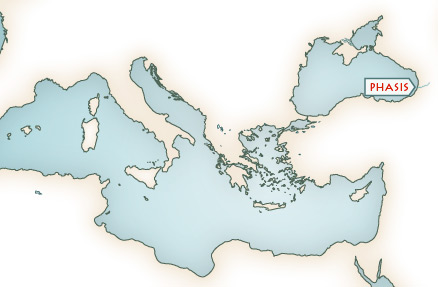
Phasis: An ancient town located on the Phasis River with ties to Argonauts and mythology.
Argives: people from the ancient city of Argos, in Peloponnese Greece.
Golden Fleece: the woolen coat of a golden haired ram. The Argonauts and Jason quested for the fleece in order to put Jason on the throne of Iolcus.
Athena Polias: The patron and defender of Athens.
Argonauts: A group of heroes that accompanied Jason to Colchis in order to find the Golden Fleece.
Lines 10-20: The Argonaut's ship then traveled through the sea, and soon an eddy emerged and the Nereids emerged naked from the whirlpool. The Argonaut Peleus falls in love with Thetis, and Thetis' father acknowledges their love.
Nereids: Sea nymphs, which are often seen accompanying Poseidon. They are depicted in mythology as young, beautiful maidens, who often come to the aid of sailors and fishermen in peril on the seas.
Peleus: a hero who was the son of Aeacus, king of the Island of Aegina. He helped in the quest to obtain the golden fleece. In addition, he married Thetis and fathered Achilles.
Lines 20-29: These heroes are born in a desired time, for they are the kin of the Gods. Peleus was the top man of Thessaly, and was embraced by Thetis, the nymph granddaughter of Tethys and Oceanus.
Thessaly: a periphery in Greece. This was the area in which Jason and the Argonauts departed from in their quest to find the golden fleece.

Tethys: An aquatic sea goddess/titan. She is the wife of Poseidon, and is the mother of all of the rivers known to Ancient Rome. Considered the embodiment of waters.
Oceanus: the ocean, believed to be a massive river that encircled the world.
Lines 29-41: Then all of Thessaly came to the house of Peleus and Thetis to give gifts for their wedding. Everyone came from all around, and the hinterland was completely abandoned for the wedding; grapevines grew untrimmed and tools that were left out had accumulated rust.
Cieros:???
Phthiotic Tempe: a valley in Thessaly, between Mount Olympus and Mount Ossa through which the River Peneus flows.
Crannon: a city in the Larissa Prefecture of Greece.

Larisa: the capital city of the Thessaly periphery and the Larissa Prefecture of Greece.

Pharsalus: Greek town in Thessaly and is famous for for the famous battle in 48 BCE in which the Roman general Julius Caesar defeated his opponent Pompey the Great

Lines 41-51: Peleus' house as a result of this was very decorated inside and out, and silver and gold were seen almost everywhere. They were even given a marriage bed with hand carved depictions of heroes in ivory. But Theseus left Adriane as she watched him from the shores of Naxos departing.
Naxos:a Greek Island in the Cyclades Islands in the Aegean Sea.

Theseus: the founder/king of Athens, known for his epic quest to assume the royal rights of his late father while fighting off such foes as the Minotaur.
Adriadne: the daughter of King Minos, who ordered Theseus to fight the Minotaur. Adriadne gave Theseus a ball of sting so that he may find his way out after killing the Minotaur, and Theseus promised that if he was successful that he would take Adriadne back home. However, after he slain the Minotaur he abandoned her on the shore of Naxos.
Piraeus: a city in the peripherary of Attica, Greece
Crete: the largest Island of the Greek Islands

Lines 51-59: Her breasts hung out of her clothes as she stared angrily out at the sea. Her sad eyes looked out in a way that made her look perplexed, yet insane.
Lines 59-68: She remained on the shore, and her shirt was ripped off and fell into the ocean. She has abandoned her cloak, but Theseus has abandoned her when she needed him.
Lines 69-80: Adriane has been made mad by Venus ever since Theseus confronted King Minos to fight the Minotaur, when Minos swept fear over Athens for the death of his son.
Androgeon/Minotaur: Androgeon, the son of King Minos, was killed by Athenians. King Minos sought to wage war on Athens because of this, but it was suggested that 7 Athenian men and women would be sacrificed to the Minotaur instead.
Lines 80-90: Soon after Theseus confronted Minos, Adriadne fell in love with Theseus, but soon after the "flame" erupted into something much worse, perhaps obsessive.
Lines 90-110: Catullus starts to digress, mourning the incident and blaming Cupid and Venus for Adriane's loss. However, he also sympathizes Theseus, as he was bound to back out of the relationship.
Lines 110-118: Catullus reminds the reader that Adriadne abandoned nearly everybody she loved, including her loving mother and her sister, to be with Theseus, who promptly left her and broker her heart.
Phaedra: Adriadne's sister, and daughter to King Minos. She also happened to be the wife of Theseus later in mythology. Theseus dumped a woman named Hippolyta for Phaedra, but Phaedra ended up dumping Theseus for Hippolyta's own son, concieved also by Theseus.
Pasiphae: The mother of Phaedra and Adriadne to King Minos, and the daughter of Helios, the sun god. She was also the mother of the Minotaur, having mated with a while bull brought from Poseidon as a curse.
Line 118-193: It is said that Adriadne spoke madly to the sea, asking why Theseus would leave him and if there would be anything that would change his mind. She decides that no woman should accept any mans promise, for they are bound to break it just as Theseus did. She recalls everything she did for Theseus, regretting it all. She prays to Venus that Theseus may suffer the same pain that she did."
Syrtis: The Latin name for the Gulf of Gabes in the Mediterranean along the coast of Africa.
Scylla/Charybdis: Two monsters that inhabited the Strait of Messina, both monsters being on different sides of the strait.
Mt. Ida: Crete's highest mountain, sacred to the Goddess Rhea.
Furies: female chthonic deities of vengeance, or typically supernatural personifications of the wrath of the deceased.
Lines 193-202: As a result of her lamentation to Venus, the sky and the seas started to storm in supernatural power, as her wish would come true. This would descend to Theseus, who was sailing home to his father.
Lines 202-228: It is said that Aegeus, Theseus' father, told Theseus that he should hang a black said when coming home if he was not successful in killing the Minotaur, and yield a white sail if he was successful.
Aegeus: Theseus' father and a founder of Athens, who the Aegean Sea was named after because he committed suicide by jumping into the sea.
Erechtheus: also a founder and king of Athens
Lines 228-241: Theseus forgot to yield a white flag, and when Aegeus saw the black flag he would commit suicide in the sea. Adriade remained sad by the events which happened, but in the meantime Bacchus loved Adriane and sought her out.
Baccus: the personification of Dionysius, the god of wine and ritual madness
Satyrs: male followers of Dionysius.
Lines 241-253: Baccus emerged and professed his deep love to Adriadne, and the wild Maenads descended from the sky. They were characterized as carrying out odd rituals, in a way similar to a Dionysian cult.
Mt. Nysa: The traditional place where Dionysius was raised by rain nymphs

lines 253-275: The story ends with Adriadne and Baccus in love, presumably going to a Thassalian wedding. Catullus' description of the manead's music and the event starts to digress to another wedding of Peleus and Thetis.
Peleus: one of the argonauts, who fathered the hero Achilles with Thetis.
Penios: one of the 300 rivers/river gods of Tethys and Oceanus.
lines 275-287: Chiron attends the wedding, bearing fragrant flowers. After the guests of the wedding leave, the house starts to smell of the flower's purfume.
Penios also came, bringing gifts such as beech leaves, a popular, and a cypress.
Chiron: a centuar who is renowned for his intelligence and kindness, which was contrary to the behavior of other centuars. He was also a mentor of Achilles.
Doric: the dialect of the Dorians of ancient Greece.
Lines 287-304: Prometheus followed after Penios, and soon after other Gods came to the wedding. however, Apollo and his sister did not come, for she has spurned Peleus and did not want to celebrate Thetis' wedding.
Phaeton: a man in greek mythology that wanted to drive the sun chariot of his father Apollo. Instead, he lost control of it and crashed.
Prometheus: the God of fire and volcanoes, also associated with forging/blacksmithing, who created humans.
Apollo: god of music, song, poetry, archery, the youth, and many other things.
Idrus: a mountainous region in Asia Minor.

Lines 304-353: Jupiter and his wife sat on ivory chairs at the wedding, and plenty of good food was there to satisfy all. Then the Moirai emerged and uttered a song of divine incantation that stated that they would be very happy together over the years. They would yield a son, Achilles, who would be known for his strength across Greece, and would be known "not for his back but for his stallworth chest." He will smite many enemies in the Trojan War, and would be known at his enemies funerals for his strength.
Moirai: goddesses of fate who would determine each person their own fate. In this case, they determined Achilles' future fate.
Emathia: the earliest known poetic term for Macedonia, a region making up the Balkan Peninsula.

Achilles: a Greek Hero, concieved by Peleus and Thetis, who became a famous character in influencing the Trojan War.
Lines 353-381: The moirai also predict that King Priam's daughter will die, describing her funeral pyre. They start to sew thread, describing the thread as the crosshairs of life. They hope that Thetis and Peleus have a happy marriage together, while hoping that Thetis's nurse and Peleus' other relatives stay out of harming their relationship.
Phrygia: a kingdom located in Anatolia, which is now modern day Turkey.

Teucrian: pertaining to the Ancient Trojans, or someone who is Trojan
Pelops: the king of Pisa in the Peloponnesus, and founder of the House of Atreus. He was also venerated in Olympia.
Dardanelles: a narrow strait in northwestern Turkey, which connects the Sea of Marmara to the Aegean Sea.

Scamander: a river/river god, born to Oceanus and Tethys, who fought on the Trojan side of the Trojan war after the Greek Achilles insulted him. The Scamander river flows from Mt. Ida, and joins the Hellespont north of Troy.
King Priam: the king of Troy during the Trojan War. When his son Hector was killed by Achilles, he begged Achilles for Hector's body, which Achilles eventually returned to Priam.
Polyxena: a Trojan princess, daughter of King Priam.
Janus: the god of gates, doors, doorways, beginnings and endings. The month January is named after him.
Dionysius: ancient Greek god of wine, and the prime of ritual madness and ecstasy in Ancient Greece. Also believed to be one of the 12 Olympians.
Lines 382-294: The Moirai sang with divinity, which before could only be sought from the gods by disguising themselves as mortals and go to the houses of heroes. The father of the gods noticed a hundred bulls descending for the festive rights, while Dionysius finished conducting the Moirai.
Delphi: an ancient settlement in Greece in the valley of Phocis. In Greek Mythology, this place was a major worshiping site for the god Apollo. Also famous for having a very significant oracle, the Delphic Oracle.

Triton: a Greek god that served as a messenger of the sea. A river in Greece and a lake in northern Africa are named after him.

Lines 382-409: As the altars of gods issued smoke, people interpreted these signs wrongly and started to act very sinfully. Many horrible atrocities happened, such as brothers killing each other or sons refusing to acknowledge dead parents. As a result, the gods felt defiled and refused to come to our weddings ever since.

No comments:
Post a Comment